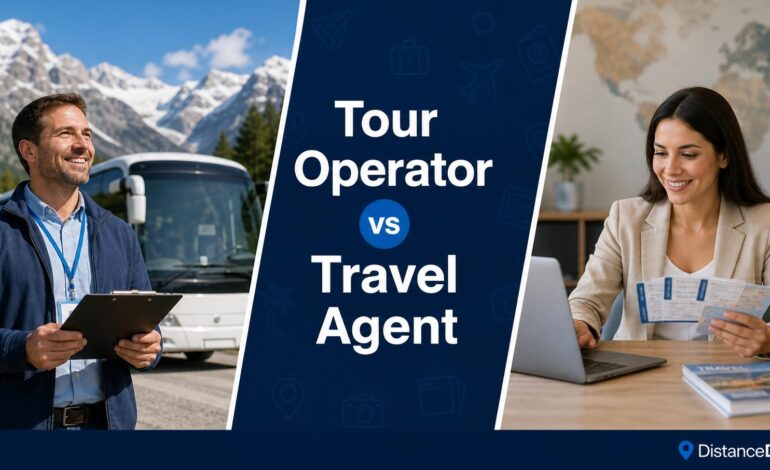

If you have ever planned a trip and got confused between a tour operator and a travel agent, you are not alone. Most people use these two terms as if they mean the same thing — but they do not. The difference between a tour operator and a travel agent goes much deeper than just titles. Knowing who does what can save you money, help you avoid bad experiences, and make sure you are talking to the right person from the start.
At DistanceData, managed by Rohan, our goal is to give travelers clear and reliable information — whether it is about road distances between cities or understanding the travel industry itself. This guide explains both roles in simple terms so you can make smarter decisions every time you plan a trip.
What Is a Tour Operator?
A tour operator is the company or person that actually creates the travel package you book. They are the ones who contact hotels, arrange transport, hire local guides, plan the itinerary, and put everything together into one complete product. When you see a “7-Night Rajasthan Heritage Tour” or a “Manali Snow Package,” a tour operator built that from scratch.
Because tour operators buy hotel rooms and transport in bulk, they get wholesale rates that individual travelers cannot access. This is why packaged tours often cost less than booking everything separately. Their strength lies in destination knowledge — they know the best hotels at each price point, the most reliable local vendors, and how to handle problems when they arise on the ground.
There are four main types of tour operators. Inbound operators focus on bringing foreign tourists into a country. Outbound operators send local travelers to international destinations. Domestic operators handle travel within the same country. Ground operators manage on-the-ground logistics at the destination, often working behind the scenes for larger operators abroad.
The most important thing to know about a tour operator is accountability. They own the product. If a hotel underdelivers, if a vehicle does not show up, or if a tour guide cancels — the tour operator is directly responsible.
What Is a Travel Agent?
A travel agent does not build travel products — they sell them. They act as a bridge between the traveler and the service providers: tour operators, airlines, hotels, and insurance companies. Their job is to understand what you need and match you with the right product from the market.
Travel agents earn through commissions paid by the suppliers they book on your behalf. When a travel agent books you on a tour operator’s package, the operator pays the agent a percentage of that sale. Some agents also charge a small service or consultation fee for complex bookings.
The real value of a good travel agent is their knowledge of the market. They know which tour operators are trustworthy, which airlines offer flexible policies, which seasons suit which destinations, and how to piece together a multi-city trip without gaps. They save you the time and stress of researching everything yourself, and they act as your advocate if a problem comes up after booking.
Difference Between Tour Operator and Travel Agent
The table below shows every major difference between a tour operator and a travel agent in one place, so you can compare both roles clearly.
| Parameter | Tour Operator | Travel Agent |
|---|---|---|
| Core Function | Creates and operates travel packages | Sells travel products made by others |
| Role in Industry | Supplier / Wholesaler | Retailer / Middleman |
| Works Directly With | Hotels, transport, guides, airlines | Tour operators, airlines, hotels |
| How They Earn | Profit margin in package price | Commission from suppliers |
| Owns Travel Assets | Often yes — vehicles, lodges | Rarely or never |
| Accountability | Full — responsible for delivery | Limited — represents the supplier |
| Customization | High — builds from scratch | Moderate — selects from available products |
| Client Relationship | Often indirect, through agents | Direct and personal with traveler |
| Best For | Packaged tours, group travel, expeditions | First-time travelers, complex itineraries |
| Pricing Power | Can discount own packages freely | Bound by supplier pricing terms |
How Tour Operators and Travel Agents Work Together
Tour operators and travel agents depend on each other more than most travelers realize. A tour operator, no matter how good their packages are, cannot personally reach every traveler in the market. They need distribution — and travel agents provide exactly that. Agents place operator packages in front of the right customers, handle bookings, and manage client communication so the operator can focus entirely on delivering the experience.
From the agent’s side, they need quality inventory to serve their clients well. Their reputation depends on the operators they recommend. A single bad operator recommendation can damage an agent’s client relationship permanently.
Here is how it works in practice. A tour operator in Jaipur creates a 6-night Rajasthan circuit covering Jaipur, Jodhpur, and Udaipur. They set a wholesale rate. Travel agents across India list this package, recommend it to clients, confirm bookings, and earn a commission. The tour operator then handles everything on the ground — transport, hotel check-ins, guides, and day-to-day logistics. Each party does what they do best, and the traveler gets a seamless experience.
Financial Model: How Each One Makes Money
Understanding how tour operators and travel agents earn money explains why they behave the way they do and where their priorities naturally lie.
| Financial Aspect | Tour Operator | Travel Agent |
|---|---|---|
| Revenue Model | Profit built into package price | Commission per confirmed booking |
| Bulk Buying Power | Yes — negotiates wholesale rates | No — sells at supplier prices |
| Discount Flexibility | Can offer direct discounts freely | Limited by operator’s terms |
| Additional Charges | Upgrades, add-ons, supplements | Consultation fees, service charges |
| Business Model | Primarily B2B through agents | Always B2C direct to traveler |
| Financial Risk | High — pre-purchases inventory | Lower — earns only on confirmed sales |
Booking directly with a tour operator can sometimes be cheaper since no commission is being paid to an agent. But working through a travel agent gives you the advantage of comparison — they can evaluate multiple operators and recommend the best fit, rather than selling you a single product.
When Should You Use a Tour Operator vs a Travel Agent?
This is the most practical question, and the answer depends entirely on your travel experience and what kind of trip you are planning.
You should go directly to a tour operator when you already know your destination and want a specific packaged experience. If you want a trekking expedition to Spiti Valley or a wildlife safari in Ranthambore, contacting a specialist operator gives you deeper expertise, more customization, and often better pricing. Tour operators are also the right choice for group travel where you want one entity to be accountable for everything from start to finish.
You should work with a travel agent when you are visiting a new destination for the first time and need expert guidance. They are also the better choice when your trip involves multiple destinations, when you do not have time to research and compare operators, or when you are planning something high-value like a honeymoon or an international family vacation. A good travel agent pays for themselves through the mistakes they help you avoid.
Who Is Responsible When Something Goes Wrong?
This is a question travelers rarely ask until something has already gone wrong. Understanding accountability before you book protects you.
When a tour operator’s service fails — a hotel is below standard, transport does not show up, or an activity is cancelled without notice — the tour operator is directly liable. They built and sold the product, and they are responsible for delivering what was promised. If you booked through a travel agent, your agent can advocate for you and chase a resolution, but the operational accountability sits with the operator.
When a travel agent makes an error — a wrong booking date, an incorrect visa requirement communicated, or a product that was misrepresented — the agent is responsible for that mistake. They represented the product to you, and if their representation was inaccurate or careless, they bear that liability.
Always document your booking clearly with both parties. Keep records of what was promised, what was paid, and what the terms were. This protects you regardless of where a problem originates.
Licensing and Regulation in India
In India, both tour operators and travel agents operate under different regulatory frameworks, and these credentials matter when you are choosing who to trust with your money.
Tour operators who seek recognition from the Ministry of Tourism India must meet financial eligibility requirements, maintain compliant office infrastructure, and demonstrate operational experience in their specific category — inbound, outbound, or domestic. Many reputable operators also hold membership with IATO (Indian Association of Tour Operators), which maintains a code of conduct among members.
Travel agents typically seek IATA accreditation to issue airline tickets, or register with TAAI (Travel Agents Association of India). Both require financial guarantees and trained staff. Always verify licensing before committing to any high-value booking, especially for international travel.
Final Word
The difference between a tour operator and a travel agent comes down to one simple idea: a tour operator builds the journey, and a travel agent helps you find the right one. Both are professionals with real expertise, but they serve different purposes and carry different levels of accountability.
Knowing which one to approach — and what to expect from each — puts you in complete control of your travel planning. For more travel guides, distance information, and trip planning resources across India, visit DistanceData, curated by Rohan to help every traveler plan smarter and travel better.