Andharban Trek Route Map: Distance & Itinerary

There are treks that take you up to a summit. And then there is the Andharban trek — a trek that takes you down, deep into one of the most magnificent forests in the Western Ghats. Andharban in Marathi means Dark Forest, and the trek is known for its dense foliage, lush greenery, and breathtaking views. The moment you step into this forest near Tamhini Ghat, the outside world disappears completely. Tall trees form a canopy so thick that sunlight filters through only in soft patches. Water flows beside you constantly. The air smells of wet earth and wildflowers.
This is one of the finest monsoon treks in Maharashtra — and unlike most treks, it is almost entirely downhill. At DistanceData, managed by Rohan, here is the complete Andharban trek route map, day itinerary, distance, highlights, and everything you need before you go.
Andharban Trek: Quick Overview
The Andharban Trek is usually done as a one-day trek. The total distance is around 13 to 14 km and takes approximately 6 to 8 hours depending on pace and weather. The trek usually starts from the village of Pimpri near Mulshi Dam and ends at Gutkha Village.
| Detail | Information |
|---|---|
| Location | Tamhini Wildlife Sanctuary, Pune, Maharashtra |
| Starting Point | Pimpri Village (near Mulshi Dam) |
| Ending Point | Bhira Village or Gutkha Village |
| Total Distance | 13 to 16 km |
| Duration | One Day (6 to 8 hours) |
| Trek Type | Descending forest walk |
| Difficulty | Easy to Moderate |
| Best Season | June to October (Monsoon) |
| Pune to Start Point | ~70 km, 2 to 3 hours |
| Mumbai to Start Point | ~165 km, 4 to 5 hours |
Andharban Trek Route Map: Stage by Stage
The Andharban trek is a gradual descending trek where you are already at height and will descend till the end. Evergreen forest covers you with shade in the first half of the trek for 6 to 8 kilometers. The trek further descends into Konkan to reach Bhira village around 4 kilometers.
The route follows the ridge above Kundalika Valley before dropping down through increasingly dense forest into the Konkan region. There are no steep climbs — but the descents on wet, slippery trail in monsoon demand careful footing throughout.
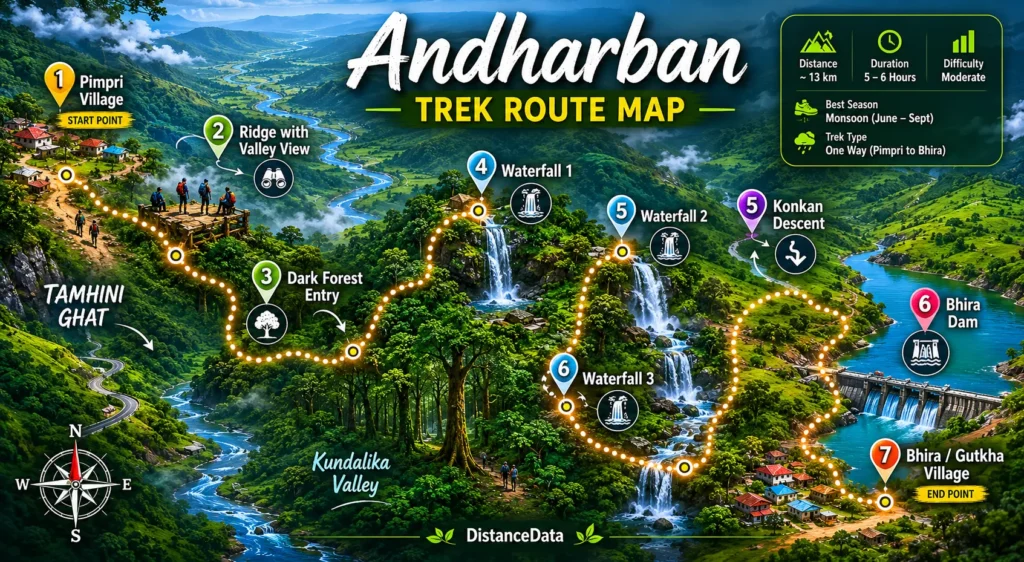
| Stage | Route Segment | Distance | Time |
|---|---|---|---|
| Start | Pimpri Village entry point | — | 6 AM start |
| Section 1 | Ridge trail with valley views | 4 km | 1.5 hrs |
| Section 2 | Dense dark forest canopy section | 4 km | 2 hrs |
| Section 3 | Three waterfall crossings | 3 km | 1.5 hrs |
| Section 4 | Descent into Konkan, Bhira Dam views | 4 km | 1.5 hrs |
| End | Bhira Village or Gutkha Village | — | 2 to 3 PM |
Day Itinerary: Andharban Trek Hour by Hour
The Andharban trek is a one-day experience but it requires planning the whole day carefully — from early departure to safe return. Most trekkers start before sunrise from Pune or Mumbai to reach the trailhead by early morning.
Here is how a typical Andharban trek day unfolds from start to finish.
Early Morning — Drive to Pimpri Village
Reaching Andharban is approximately 70 km from Pune via Mulshi, taking 2 to 3 hours. The route passes through the scenic twists of Tamhini Ghat, especially beautiful in monsoon. Most organized groups depart Pune at 5 to 6 AM to reach Pimpri Village by 7:30 to 8 AM. If you are coming from Mumbai, the journey is approximately 165 km and takes 4 to 5 hours, so a midnight departure is common.
Reach Pimpri Village early, collect forest permits, use the washroom facilities — these are the only ones available before the endpoint — and begin the trek by 8 AM at the latest.
Morning — Ridge Section and Valley Views
The first 4 kilometers of the Andharban trek follow the ridge above the Kundalika Valley. Walking on this ridge offers a fantastic view of the Kundalika Valley, Bhira Dam, Devkund Waterfall, and the mountain ranges of Tamhini Ghat.
On monsoon mornings, the valley below is often filled with cloud and mist — making the views from the ridge genuinely spectacular. This is the most photogenic section of the entire trek and the one that justifies every early morning departure.
Mid Morning — The Dark Forest
This is the section that gives the trek its name. As you descend further into the forest, the tree canopy closes in overhead and the light drops significantly. From the moment you step into the forest near Pimpri village, the outside world fades away. Tall trees form a natural canopy, sunlight filters through in soft patches, and the sound of flowing water follows you almost constantly.
The dark forest section is 4 to 5 kilometers of immersive jungle walking. Moss covered rocks, hanging vines, and the constant sound of water make it feel completely removed from civilization. Walk slowly here — the trail is slippery and the atmosphere rewards those who are not in a rush.
Late Morning — Three Waterfall Crossings
The trek involves crossing three major waterfalls and navigating through a dense, slippery forest. These crossings are the most adventurous part of the entire route. During peak monsoon, the water levels can be high and the rocks beneath are extremely slippery. Remove your footwear if the crossing feels unstable — bare feet grip wet rock better than shoe soles in most cases.
The waterfalls themselves are stunning. The sound of falling water, the mist in the air, and the green forest surrounding each crossing makes these the most memorable moments on the Andharban route.
Afternoon — Konkan Descent and Bhira Village
The final section descends through the forest into the Konkan region. The same valley is the origin of the Kundalika river, famous for its white water Kolad river rafting. The terrain opens up gradually as you approach Bhira Dam and Bhira Village at the end point. Most trekkers reach the endpoint by 2 to 3 PM, where transport back to Pune or Mumbai can be arranged.
Andharban Trek Route Highlights
The Andharban trek packs an extraordinary amount of natural variety into 13 kilometers of mostly downhill forest trail.
| Highlight | Location on Route |
|---|---|
| Kundalika Valley panoramic view | Ridge section — early morning |
| Bhira Dam aerial view | Ridge section |
| Devkund Waterfall visible from ridge | Morning section |
| Dense dark forest canopy | Mid-trail dark forest section |
| Three waterfall stream crossings | Late morning section |
| Tamhini Ghat mountain ranges | Throughout upper section |
| Konkan landscape views | Final descent section |
| Bhira Dam close up | Near end point |
What Makes Andharban Trek Unique
Most treks in the Western Ghats involve significant climbing. The Andharban trek is almost entirely a descent — which makes it far more accessible than it sounds, but no less demanding. Wet rocks, slippery roots, and constantly flowing water across the trail keep every step of the descent requiring full attention.
What sets the Andharban Trek apart is its atmosphere. Unlike many popular treks that involve steep climbs, Andharban is mostly a descending forest walk, making it accessible yet deeply rewarding. The biodiversity inside Tamhini Wildlife Sanctuary is exceptional — birds, butterflies, and if you are lucky, glimpses of the wildlife that calls this forest home.
The trek is also one-way — start and endpoint are different. The starting and ending points are entirely different for the trek to Andharban, which are at least 40 kilometers away from each other by road. This means you need to arrange return transport from Bhira Village in advance, or join an organized group that handles logistics.
Permits and Forest Regulations
Andharban trek permission issued in limited numbers by the forest department is compulsory to enter the forest. The trek gets banned during peak monsoon season as it is the breeding period for animals in the forest. The three waterfall crossings become impossible to cross on a rainy day.
Always check the current permit status before planning your trip. The forest department limits daily entries to protect the ecosystem — walk-in permits may not always be available on weekends. Booking through an organized trek operator who handles permits is the most reliable approach.
Music, Bluetooth speakers, and plastic are prohibited inside the forest. Carry all your waste out with you. The Andharban forest stays pristine because trekkers have respected it — keep it that way.
How to Reach Andharban Trek Starting Point
The trek starts at Pimpri Village near Mulshi Dam in Pune district.
| From | Distance | Route | Time |
|---|---|---|---|
| Pune | ~70 km | Via Mulshi Dam, Tamhini Ghat | 2 to 3 hrs |
| Mumbai | ~165 km | Via NH48, Khopoli, Tamhini | 4 to 5 hrs |
| Navi Mumbai | ~140 km | Via Khopoli or Lonavala | 3 to 4 hrs |
Public transport options include buses to Mulshi, Vile, or Tamhini, followed by local autos or jeeps to Indavali. However, driving or joining a group tour is generally more convenient. Self-drive is possible but remember the start and end points are different — you will need someone to drive your car from Pimpri to Bhira, or use a taxi service for the return journey.
Trek Cost for Andharban trek
The Andharban trek is one of the most affordable full-day treks near Pune and Mumbai.
| Package Type | Cost Per Person | Includes |
|---|---|---|
| Self Organized | ₹300–₹600 | Forest permit only |
| Organized Group (Pune) | ₹900–₹1,500 | Transport, permit, guide |
| Organized Group (Mumbai) | ₹1,200–₹2,000 | Transport, permit, guide, breakfast |
Best Time for Andharban Trek
The trek is open from June to September. Andharban trek gets banned during peak monsoon season as it is the breeding period for animals in the forest.
| Season | Months | Conditions |
|---|---|---|
| Early Monsoon | June – July | Forest green, waterfalls starting, light rain |
| Peak Monsoon | August | Maximum waterfalls, slippery trail, permit restrictions |
| Post Monsoon | September – October | Best balance — green forest, manageable trail |
| Winter | November – February | Pleasant weather, less greenery but clear views |
| Summer | March – May | Hot, dry, forest less lush — not recommended |
Post-monsoon season is also a great idea as the forest is dense and the winter chills make the trek even more pleasant. September and October give you the best of both worlds — the forest is still deeply green from monsoon rains but the trail is more manageable than August.
What to Carry
The Andharban trek is a wet, slippery, forest descent. Packing right makes the difference between a great experience and a miserable one.
| Item | Why Needed |
|---|---|
| Waterproof trekking shoes | Wet rocks and stream crossings |
| Extra pair of clothes | You will get wet guaranteed |
| Rain poncho or jacket | Sudden rain showers common |
| 2 liters of water minimum | No water sources safe to drink |
| Snacks and packed lunch | No food stalls on trail |
| Insect repellent | Dense forest, leeches in monsoon |
| Trekking poles | Helpful on slippery descents |
| Ziplock bags for phone | Protect electronics from water |